Daily sailingsUp to 12 / day365 days a year, per direction
🌀
First & last from Rostock00:45 — 22:3012 fixed departure slots
🚀
Onward from GedserCopenhagen in 1.5 hØresund Bridge to Malmö / Sweden
Departures from Rostock
00:45
01:30
04:15
04:30
06:00
09:00
11:15
13:30
15:45
18:00
20:15
22:30
Prices at a glance (one-way)
🚗
Car (up to 6 m)€65 – €270Depends on season & tariff
🏍
Motorcyclefrom €44Incl. rider
🚶
Foot passenger€14 – €28Off-season → peak
🚲
Bicycle surchargefrom €1.50Per crossing
Children aged 4–15 get a 50 % discount on foot/bike/car-passenger fares. Tickets bought at the harbour incur a handling fee from €15 — book online to avoid it.
See at a glance when the Rostock–Gedser crossing is cheapest. Prices shown are the lowest available fare per day for a car up to 6 m, one-way, pulled live from the Scandlines booking system. Click a day to load the full timetable below.
Lowest one-way fare per day, car up to 6 m (daily price index, as of 27.10.2026, 10:28 Uhr). Low Price = number of sailings still bookable at the Low Price fare.
Day
Rostock → Gedser from
Low Price sailings
Gedser → Rostock from
Low Price sailings
Tue 27 Oct
€80.00
6 of 9
€80.00
2 of 9
Wed 28 Oct
€80.00
7 of 9
€80.00
3 of 9
Thu 29 Oct
€65.00
9 of 9
€65.00
9 of 9
Fri 30 Oct
€65.00
9 of 9
€65.00
6 of 9
Sat 31 Oct
€65.00
9 of 9
€65.00
5 of 9
Sun 1 Nov
€65.00
3 of 6
€65.00
4 of 5
Mon 2 Nov
€65.00
3 of 5
€65.00
5 of 5
Tue 3 Nov
€65.00
4 of 5
€65.00
5 of 5
Wed 4 Nov
€65.00
5 of 5
€65.00
5 of 5
Thu 5 Nov
€65.00
5 of 5
€65.00
3 of 5
Fri 6 Nov
€65.00
5 of 5
€65.00
4 of 5
Sat 7 Nov
€65.00
5 of 5
€65.00
3 of 5
Sun 8 Nov
€65.00
3 of 5
€65.00
5 of 5
Mon 9 Nov
€65.00
5 of 5
€65.00
5 of 5
Cheapest third Mid-range Most expensive No data / sold out
Rostock–Gedser Ferry Schedule and Prices
Departure
Arrival
Ship
Status
Standard
Flex Price
Low
Action
Sailings Rostock → Gedser on Tuesday, 27 October 2026
· Car up to 6 m · one-way prices from the Scandlines booking system, checked 26 Oct 2026, 22:30 (German time).
“sold out” = this fare is no longer bookable for that sailing.
The ferry from Rostock to Gedser runs several times a day. Departures from Rostock are at the following times: 00:45, 01:30, 04:15, 04:30, 06:00, 09:00, 11:15, 13:30, 15:45, 18:00, 20:15, and 22:30.
Scandlines prices depend on demand and booking time rather than a fixed season. For a car up to 6 m including up to 9 passengers, a one-way ticket starts at 65.30 EUR in the Low Price fare (online only, at least 3 days in advance, non-changeable), 82.70 EUR in the Standard fare and 157 EUR in the fully flexible Flex fare. Booked at the port, the Standard fare starts at 147 EUR.
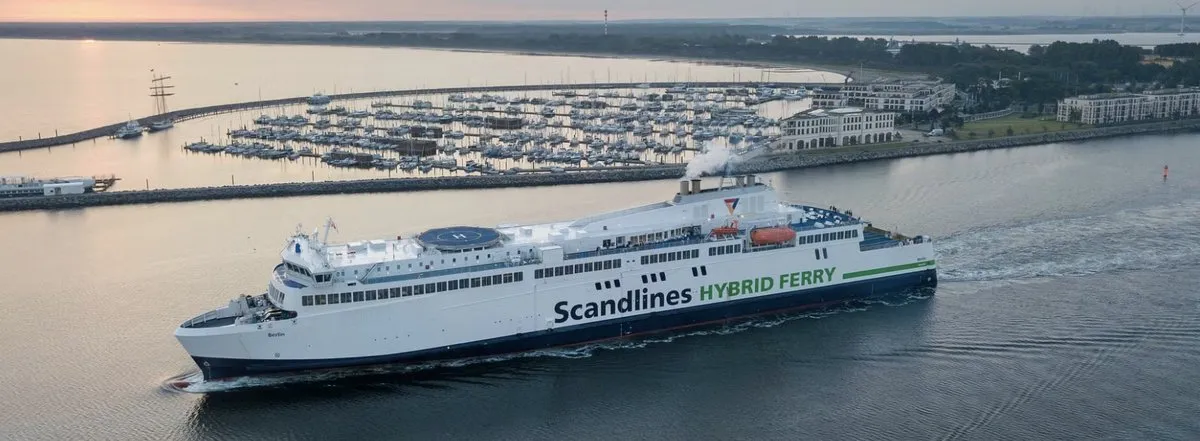
The Rostock–Gedser ferry route is operated by Scandlines. Modern hybrid ferries are used, which are both environmentally friendly and comfortable.
The first ferry from Rostock to Gedser departs at 00:45.
The crossing takes about 2 hours — allow extra time for check-in and boarding.
The costs for the crossing with a car vary depending on the season. A car up to 6 m including up to 9 passengers costs from 65.30 EUR (Low Price) to 157 EUR (Flex) one way, depending on the fare and how early you book.
Foot passengers pay 31 EUR for the day return ticket, valid for the outward and return crossing on the same calendar day. Scandlines does not sell a single-journey foot passenger ticket on this route. Taking a bicycle costs from 3 EUR extra.
The connection is offered several times a day, with up to twelve departures per day.
Children aged 4–15 travel at half price as foot/bike/car passengers. The limited Low Price tariff is the cheapest way to book, and online booking avoids the port handling fee (from €15) charged at the harbour.
For booked vehicles, the check-in time is up to 15 minutes before departure. Passengers without a vehicle should arrive in Rostock up to 30 minutes and in Gedser up to 15 minutes before departure. The terminal bus in Rostock departs 20 minutes before the ferry's departure.
Onboard the Rostock–Gedser ferry you can pay in euros (EUR) or Danish kroner (DKK), and credit/debit cards are accepted everywhere. In Denmark itself, cash is rarely used — card payments work almost everywhere, including public toilets and small kiosks. German and EU bank cards work without issues; expect a small FX markup if your card bills in euros. ATMs (Hæveautomat) are available in every larger town.
Denmark is in the Schengen Area, so no passport check is mandatory for EU citizens. However, Denmark has reinstated temporary internal border controls and random ID checks do happen on the Rostock–Gedser ferry and at the Gedser port. Always carry a valid passport or national ID card. For non-EU travellers, a valid passport is required, and short-stay visa rules apply. The ETIAS system for non-EU visa-exempt travellers is expected to launch in late 2026 — check requirements before your trip.
Book as early as possible — the Low Price / Economy tariff is limited per sailing and sells out first on weekends and holidays. Booking 4–8 weeks ahead for summer weekends is strongly recommended. Weekday crossings outside of school holidays and early-morning departures (04:15, 04:30, 06:00) tend to be cheapest. Online booking also avoids the port handling fee (from €15) charged for tickets bought at the harbour.
Yes, pets are welcome. Dogs travel for a small surcharge and must be kept on a leash or in a carrier in the public areas; there are dedicated pet-friendly outdoor areas on deck. For travel from Germany to Denmark, your pet needs an EU pet passport, a valid rabies vaccination (at least 21 days old) and a microchip. Unlike for the UK, no tapeworm treatment is required to enter Denmark.
Rostock Ferry Terminal: arrival & check-in
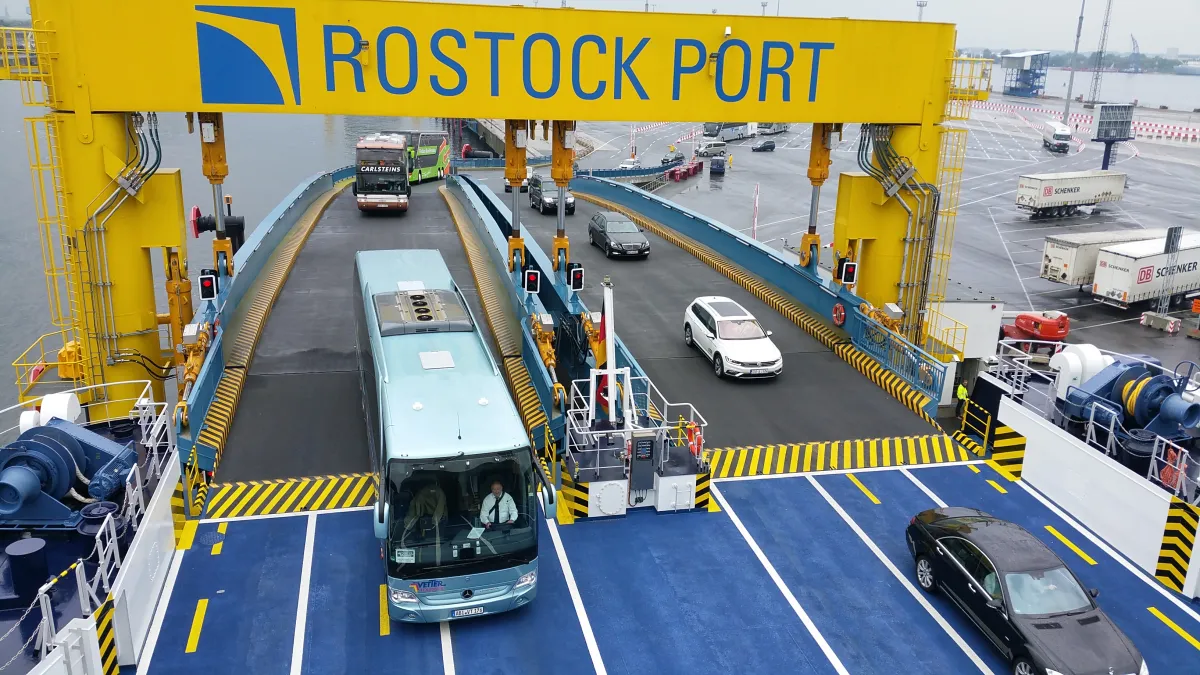
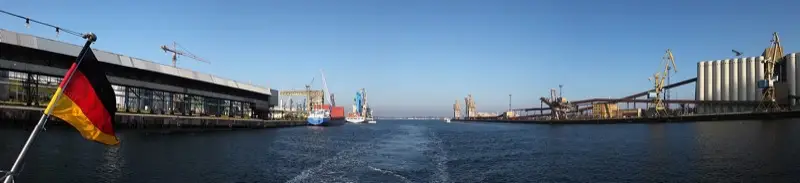
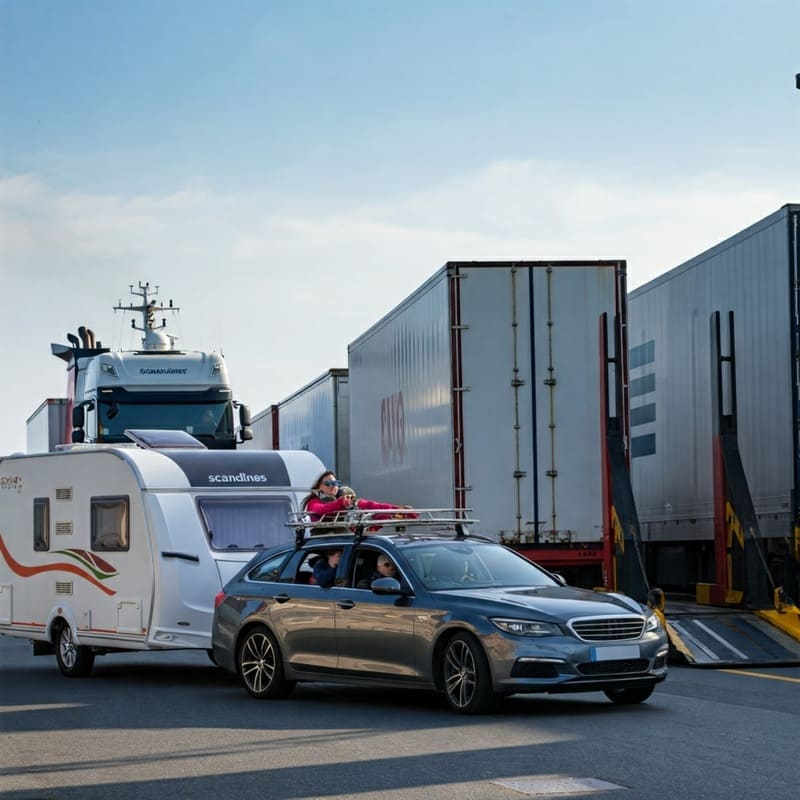
The Scandlines terminal sits in Rostock's Overseas Port (Überseehafen), about 12 km north of the city centre. Everything — drive-up, check-in booths, parking, bus stop — is within a compact area, so first-time visitors rarely get lost. Below: what it actually looks like, plus the exact location on the map.
Check-in lanes at the terminalRostock Overseas Port from aboveWaiting lanes & parking areaTrain + bus 45 from Rostock Hbf
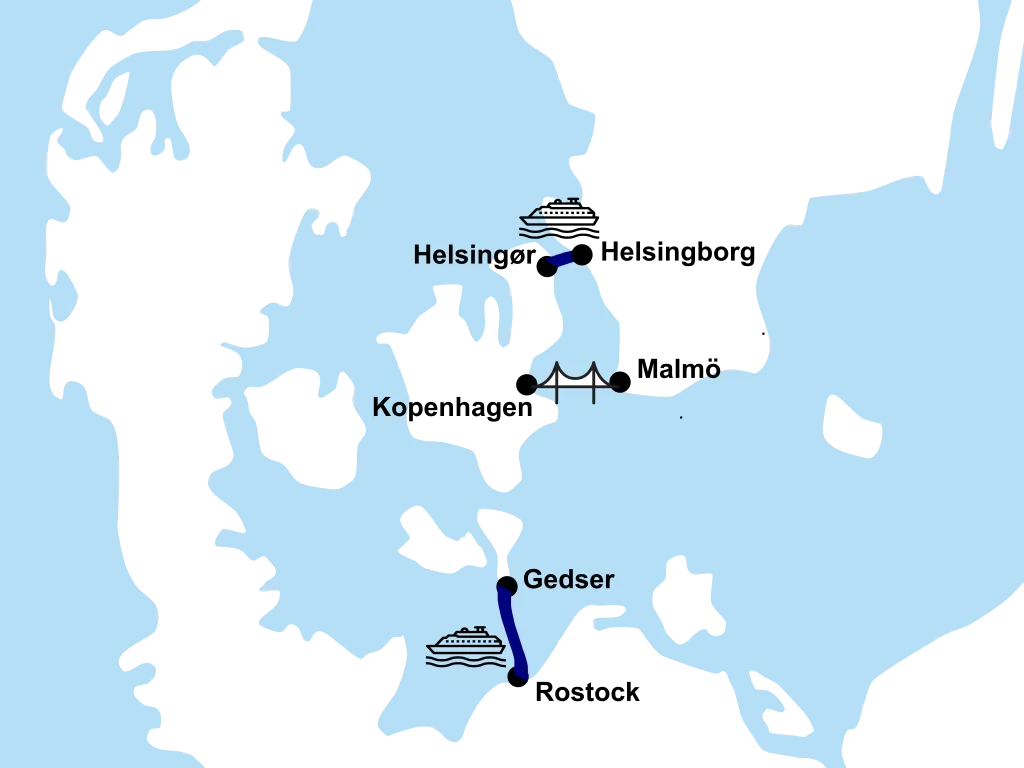
If you want to travel from Germany to 🇩🇰Denmark, take the ferry from Rostock to Gedser. This crossing is fast and easy.
If you want to continue to 🇸🇪Sweden, drive from Gedser to Copenhagen and cross the Øresund Bridge to Malmö.
Alternatively, you can drive from Gedser to Helsingør and take the ferry to Helsingborg. Both routes are convenient and easy to reach Sweden.
By car or caravan to the ferry
The journey to the Scandlines ferry terminal in Rostock by car is well signposted and easy to find. The terminal is located in the Rostock Overseas Port and is easily accessible via the A19 motorway. Follow the A19 towards Rostock and take the Rostock-Überseehafen exit (exit 6). Then follow the signs to the Overseas Port and continue to the ferry terminals. There are plenty of parking spaces for short and long-term parking. Signs and pictograms help with orientation and guide you to the appropriate lanes for different vehicle types and check-in options.
Location and arrival at the ferry terminal without a car as a pedestrian
The Scandlines ferry terminal in Rostock is conveniently located and easy to reach. From the Rostock main station, the journey is simple:
Start at Rostock Main Station: Here you take the S-Bahn Line S1 towards Warnemünde. The travel time to the next relevant station is about 15 minutes.
Transfer in Lütten Klein: Get off at Lütten Klein station. Here you will find direct connections to the bus network.
Continue with bus 45: Take Bus 45, which will take you directly to the ferry terminal. The bus ride takes about 20 minutes depending on traffic.
Overall, you should allow approximately 35-40 minutes for the entire journey from the main station to the ferry terminal, depending on transfer times and the time of day.
By bike to the ferry
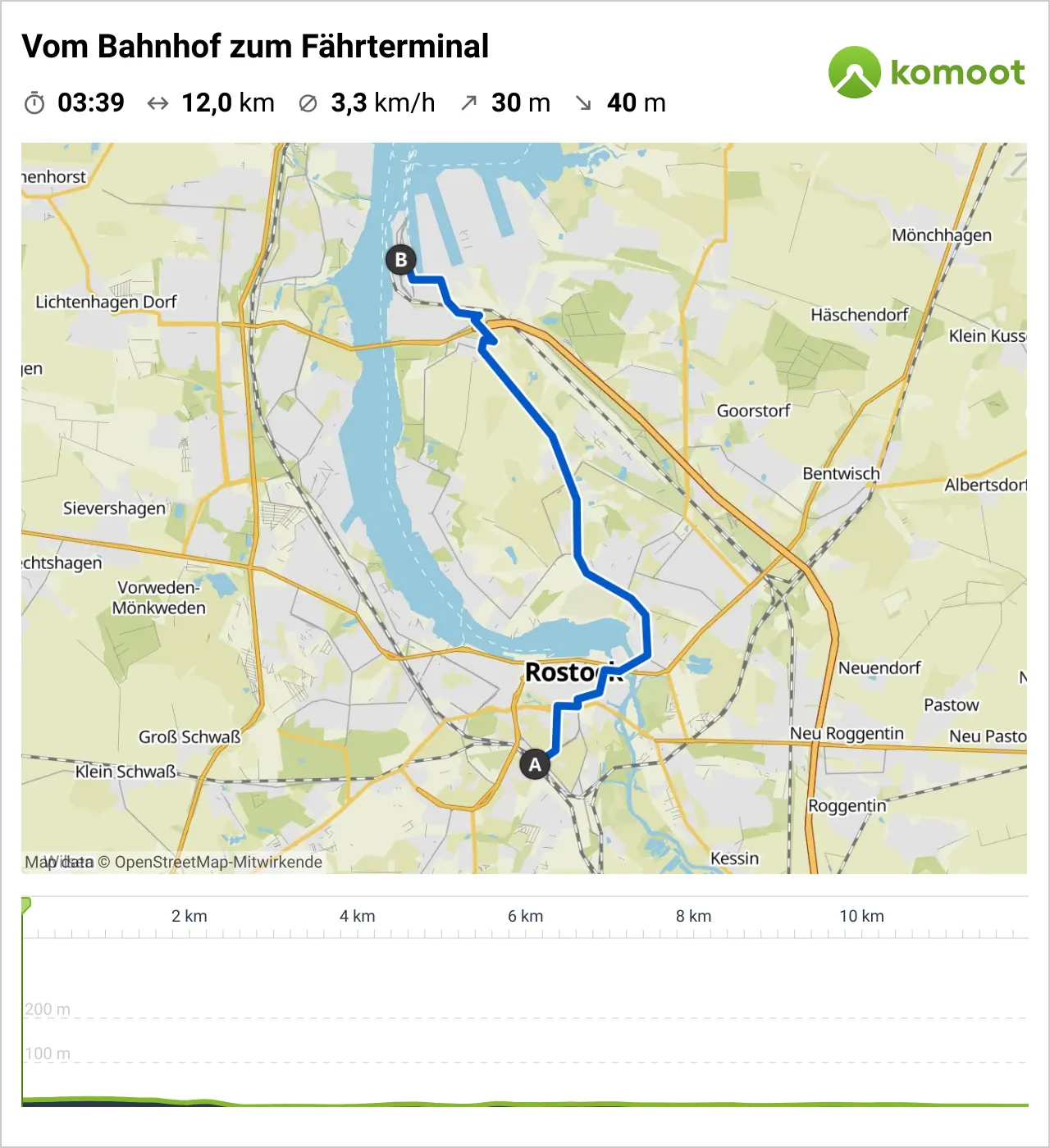
Start your ride at Rostock Main Station in the heart of the city. Follow the well-developed bike paths towards the Warnow. After a few kilometers through cozy residential areas, you will finally reach Toitenwinkel, where you leave the city of Rostock behind.
The second half of the route runs through picturesque and absolutely quiet landscapes. Without significant inclines, this route is also suitable for children.
You can find the exact route in the attached route map.
A day trip to Gedser offers a wonderful opportunity to explore Denmark's southernmost town and its surroundings. Gedser is located on the island of Falster and is known for its charming harbor, picturesque landscapes, and historical landmarks.
Attractions in Gedser
In Gedser, there are numerous attractions and activities for visitors of all ages:
Gedser Odde: Visit the southernmost point of Denmark and enjoy the stunning view of the Baltic Sea.
Gedser Remise: A railway museum showcasing the history of the railway in the region and housing numerous historical locomotives and carriages.
Gedser Harbor: Stroll along the harbor, watch the boats, and enjoy the fresh sea air.
Gedesby Beach: A beautiful sandy beach, perfect for relaxing and swimming in the summer.
Gastronomy
Gedser offers a variety of restaurants and cafes serving delicious Danish cuisine. Try local specialties like fresh fish and seafood.
Outdoor Activities
For nature lovers, the surroundings of Gedser offer many opportunities for hiking and cycling. Explore the idyllic landscapes and enjoy the peace and quiet of nature.
Return Trip
After an eventful day in Gedser, the ferry will take you back to Rostock. Use the return trip to relax and reflect on the day's experiences.